
The Accords
Eight hundred years ago the great wyrms fought a war that cracked a continent. The survivors met at the Emberwright Forge and beat the terms of peace into a ring of iron plates, one per signatory. Each plate carries a bloodline. It cools when the last of that line dies, and cracks when the line breaks terms.
I.1 · The original clauses
I. No dragon may kill another dragon.
Every other clause and eight centuries of case law hang off this one. All conflict between dragons must therefore run through intermediaries, which is why adventurers exist as a recognized profession.
II. No dragon may hold land it cannot personally overfly in a day.
A hard cap on the size of a realm. A Wright that wants more has to take it indirectly, through vassals, client states and tribute rather than annexation, so none can grow its way to dominance. The clause binds a dragon and says nothing about dragons acting together, which is the gap the Draconic Empire was built in.
III. The Forge is neutral ground.
Every realm keeps an embassy there, and no signatory may take true form inside the walls. It is the closest thing the world has to a capital.
I.2 · The Second Beating
Two hundred years ago a supplementary clause was hammered onto the plates. It followed a war in which two Wrights spent eleven years personally burning each other’s realms and both emerged ruling ash. The lesson drawn was economic rather than moral. A Wright’s power is its realm — granaries, bloodlines, tribute, tax base — and taking the field is the fastest known way to lose all of it.
A signatory who takes wing in war forfeits the protection of the Accords for the duration.
The clause withdraws coverage. The instant a Wright is airborne over a battlefield every other dragon may legally kill it without forfeiting anything itself.
It is the ideal shape for a deterrent, since nothing has to enforce something that is simply true. It also grows with how much a Wright has to lose, which is why the great Wrights are the most cautious rulers alive and the landless ones the most dangerous.
I.3 · Enforcement
The Forge has never needed an army, because it does not do the punishing — the other signatories do. Three cracked plates hang in the ring, all of them from the first century after the signing, and none of the three reached a court. The other signatories simply acted together, and by every surviving account they were glad of the excuse.
Restraint rests on one expectation: a house that breaks terms and does not correct itself will be destroyed within a season of its plate finishing the crack.
The question nobody at the Forge will put in writing is what happens if a plate cracks and nobody comes.
I.4 · The loopholes
The seams were found early and have been worked ever since. A Wright going to war retains a plate-reader the way a modern state retains counsel, and pays accordingly.
- Indirect killing
- A dragon may not kill a dragon. May it collapse a mountain a dragon happens to be under? The Forge has ruled eleven times and contradicted itself at least four.
- Duels of Restraint
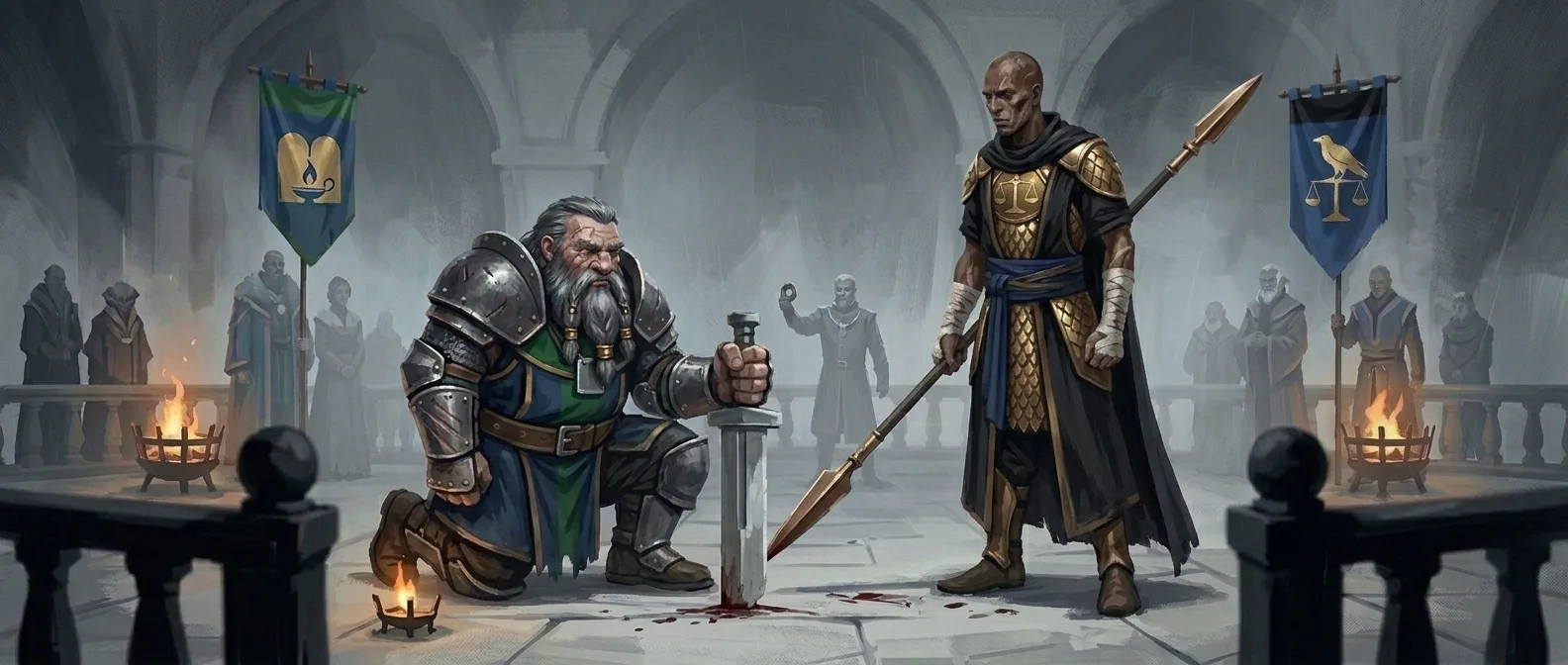
- A formal, witnessed, non-lethal fight, usually in humanoid form and with weapons rather than breath. The loser concedes a claim. It is the only circumstance in which two dragons may legally strike each other, so duels settle a real share of border disputes. Ancient Wrights display the scars.
- The unsigned
- Setting an Unbound dragon on a rival is the gravest accusation one Wright can make against another, and hard to prove. The same charge over a True dragon is unprovable and never argued, since an Unbound dragon can be offered a contract and a True one cannot.
- Attribution, not method
- Under Clause I the method does not matter. Poison, a knife in a hosting-hall and thirty years of occult work arranging for an heir to go mad are the same offence, and in every case the only question anybody argues is attribution. A house is liable for everything it orders, and no mortal in the chain takes any of that weight off it. What will not stay deniable is repetition. One killing is an incident, and the iron ignores it; a habit of them is a policy, and policy is the one thing the fire reads.
I.5 · How wars are fought
Two dragon realms at war deploy no dragons, and the wars that result are long.
- Mortal armies matter
- Two centuries of unchecked military development have given the realms professional officer corps, proper siege trains, standing legions and mortal generals with continental reputations. A famous general is a strategic asset, and is guarded and targeted as one.
- Cities are built for it
- Siege-cellars, dispersal plans and dispersed granaries, inherited from the era when dragons did fly. The measures raised the cost of a visit enough to deter a wyrm rather than repelling one, and they are still maintained at public expense.
- Nothing forces a decision
- The only assets that could end a war quickly are the two forbidden from being used. Wars are therefore decided by siege, attrition and sustained pressure on a rival’s tax base, with most of the work done by people the Accords do not cover.