
Found Cities
The six found cities are the great architectural wonders of the world. Each is built around an ancient structure on a scale that no one alive can build today: a fallen tower large enough to house entire districts, a burial wall spanning a canyon, or immense stone rings through which ships enter a harbour. People settled in and around these structures long after their builders had gone. The cities are called “found” because their great structures were already there when the settlements began.
The older world
Some structures were built by the mortal civilisations that preceded dragon rule, more than eight hundred years ago. Masons call these remains old work. Others are older still, with rooms and fittings sized for inhabitants about three metres tall. These are called tall work. Their builders are unknown, and later peoples have repeatedly adapted their buildings.
Each city preserves a rune assigned to its site during the tall era. These marks predate the present settlements. Their original meanings are unknown, although inhabitants associate their forms with the landmarks around them.
Much of each city remains empty. Beyond the inhabited streets are sealed chambers, unused galleries and buildings quarried for stone. Current builders can add floors, reinforce walls and support failing bridges, but the original methods of construction have been lost.
VII.1 · The Forge
Central mountains About 30,000 residents
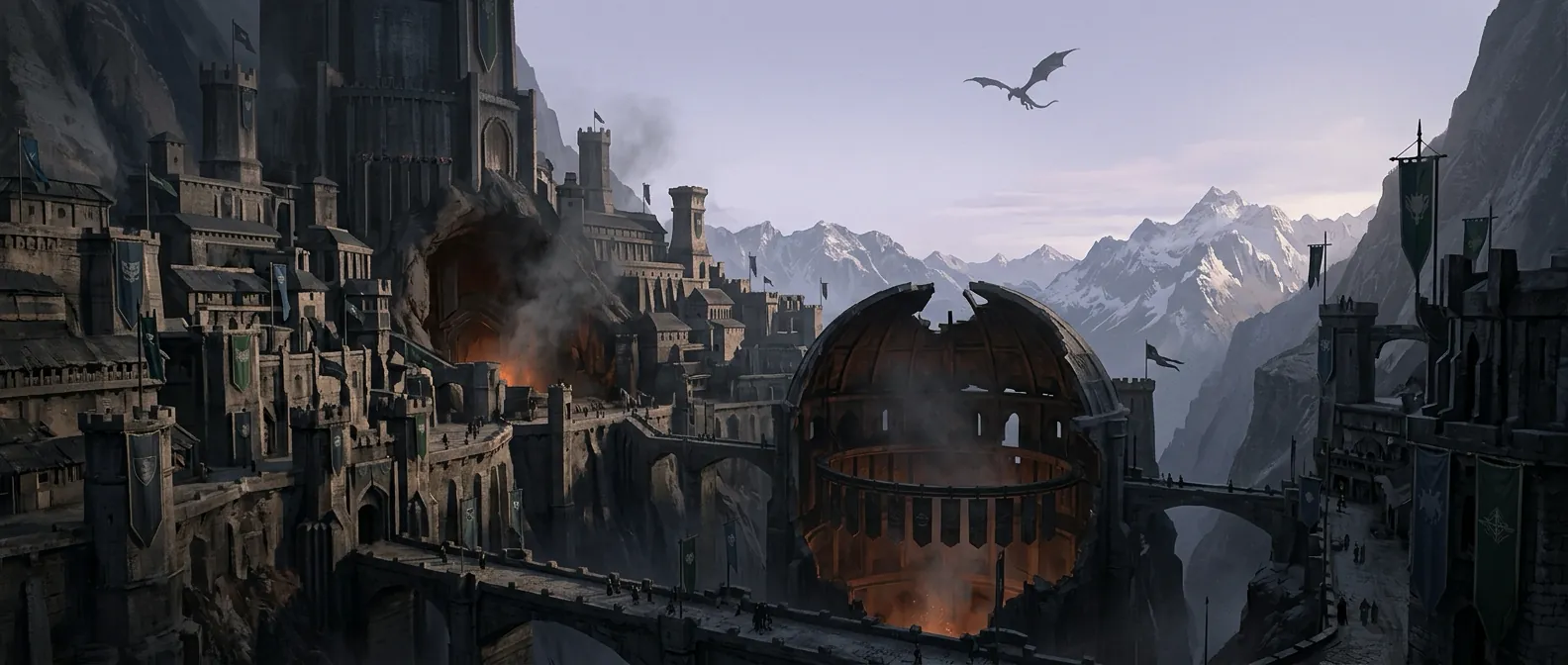
The Forge occupies the cliffs of a narrow mountain valley. At its centre stands a vast circular hall beneath a partly open, ribbed dome. Stone bridges connect it to terraces on both sides of the valley. Fire lights the lower chamber orange, and smoke rises through the roof. Fortified buildings climb the slopes behind it, with house banners hanging from their towers and balconies.
Inside the hall, eighty-one iron plates hang from chains above the fire pit. Each belongs to a dragon bloodline that signed the Emberwright Accords, the treaty governing dragon rule. A stone walkway surrounds the fire, allowing visitors to read the plates. The anvil used to make them remains in the hall. Both the hall and anvil were already ancient when the dragons gathered here eight hundred years ago.
The city is the permanent meeting place of the ruling houses. Its embassies occupy the buildings along the bridges and terraces, and the houses govern the district jointly through their assembly. Dragons must remain in their humanoid forms inside the walls. Embassy space is scarce: the ancient walls cannot be extended, and houses trade individual rooms. Eleven houses currently dispute the allocation.
VII.2 · Onegate
The Thurmgar Deeps About 38,000 residents
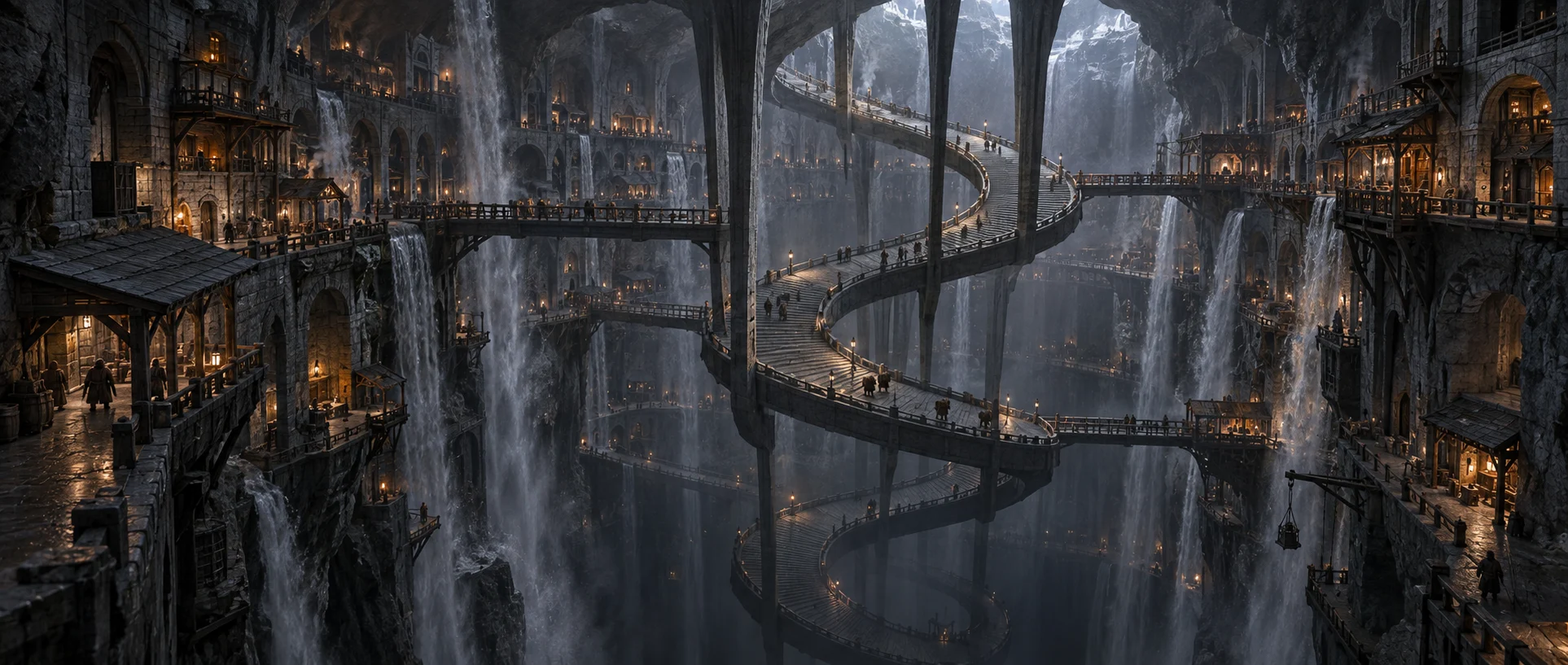
Onegate surrounds the Hanging Stair, a broad stone spiral descending from the roof of an immense underground shaft. Stone ribs suspend it over open space. Short bridges connect its landings to galleries in the shaft walls, while water falls past them into reservoirs below. From an upper bridge, residents can see the lights of several districts beneath their feet.
The stair is wide enough for eight people to climb abreast. Porters carry goods between its landings, and wooden shelters protect the busiest crossings from spray. About a third of the city’s excavated space is lit. The stair continues below the occupied galleries into darkness.
The dwarves who settled Onegate found rooms with four-metre ceilings and added wooden lofts to make use of the height. Their masons have stopped repeating the traditional claim that the clans built the earliest structures. House Emberkeel rules the city, whose banks, metal-testing businesses and underground trade routes serve settlements throughout the mountains. Its name comes from a legal dispute: dwarven rulers argue that a city beneath a mountain should count as the single gate visible from above. An internal survey could change how much territory those rulers are judged to control.
VII.3 · Natronhalt
The eastern canyons · South of Quarrelford About 3,000 living residents · More than 200,000 buried
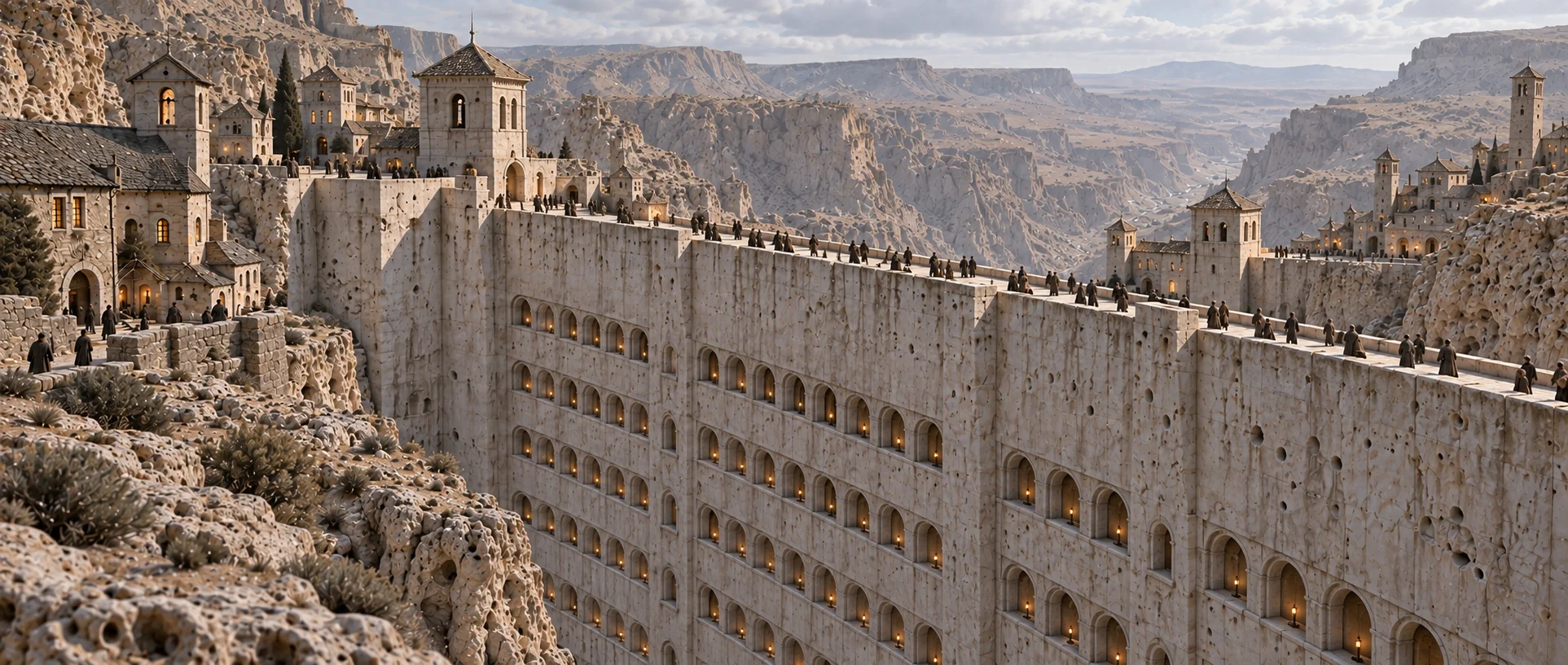
The White Wall spans a canyon, rising three hundred metres above the river. Nine rows of openings cross its pale face. Behind them, galleries run through sixty metres of stone. Funeral processions enter from the canyon sides and cross the open passages high above the valley. The river passes through a single arch at the wall’s foot.
Later inhabitants cut burial chambers into the wall and divided its rooms into family tombs. The living occupy the upper galleries and buildings around the entrances. Lifts lower coffins to the burial levels, while stairs carry relatives between them. The wall’s original purpose is unknown. The city takes its name from natron, the salt used to preserve bodies, and the stopping place where the dead are received and registered.
House Umbermere governs Natronhalt and controls the main entrance. Its officials record burial rights, while the burial orders manage the tombs. Eleven burial orders, together called Natron Eleven, carry the dead here from across the continent. Warring armies allow their members through siege lines because both sides need their services. Some thirty ruling houses have family graves in Natronhalt, giving them a shared reason to protect it. The orders stop excavating at the ninth and lowest gallery; their official explanation has changed three times in eight hundred years.
VII.4 · Nine Moorings
The Storvald Gulf About 22,000 residents
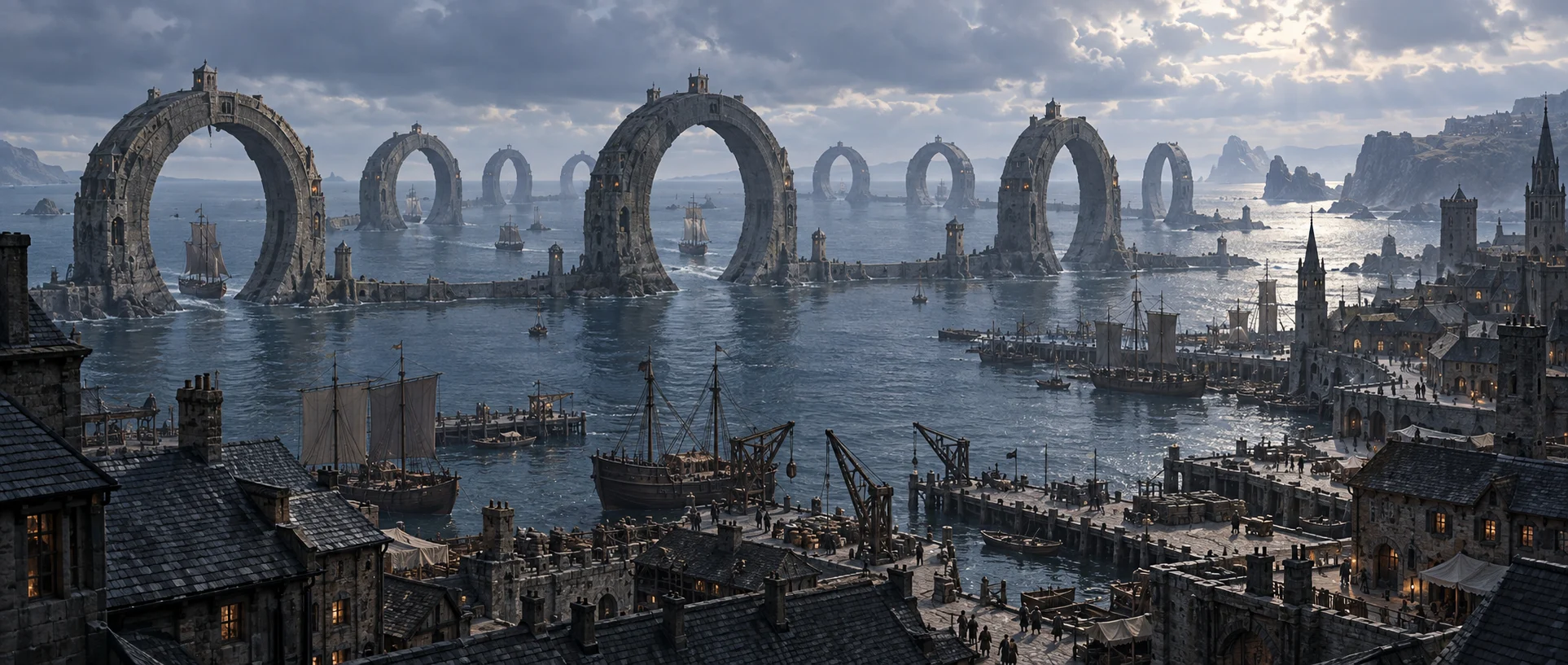
Nine stone rings stand upright in the Storvald Gulf, each rising about ninety metres above the water. Ancient breakwaters join their lower sections and enclose the harbour. Ships enter through the openings, several of which are wide enough for vessels to pass side by side. From the gulf, the rings rise above the waterfront buildings, with ships visible through the stone.
Stairs and passages run inside the rings. Harbour pilots, who guide ships through difficult waters, keep lookout stations in their upper curves. Boats carry the pilots between the rings and the eastern quays, where cargo arriving down the Anvilwater river is transferred to seagoing ships.
The elven House Nuirendil rules the port. Its ancient stonework is beyond the abilities of current builders, and damaged berths can only be supported and closed. Nineteen of the original thirty-one remain usable. Every closure raises the tolls at those still open. Northern rulers have repeatedly helped fund repairs and have twice asked to place the harbour under joint control.
VII.5 · Fetchfield
The Coltfold · Solmarch grain plain About 9,000 residents
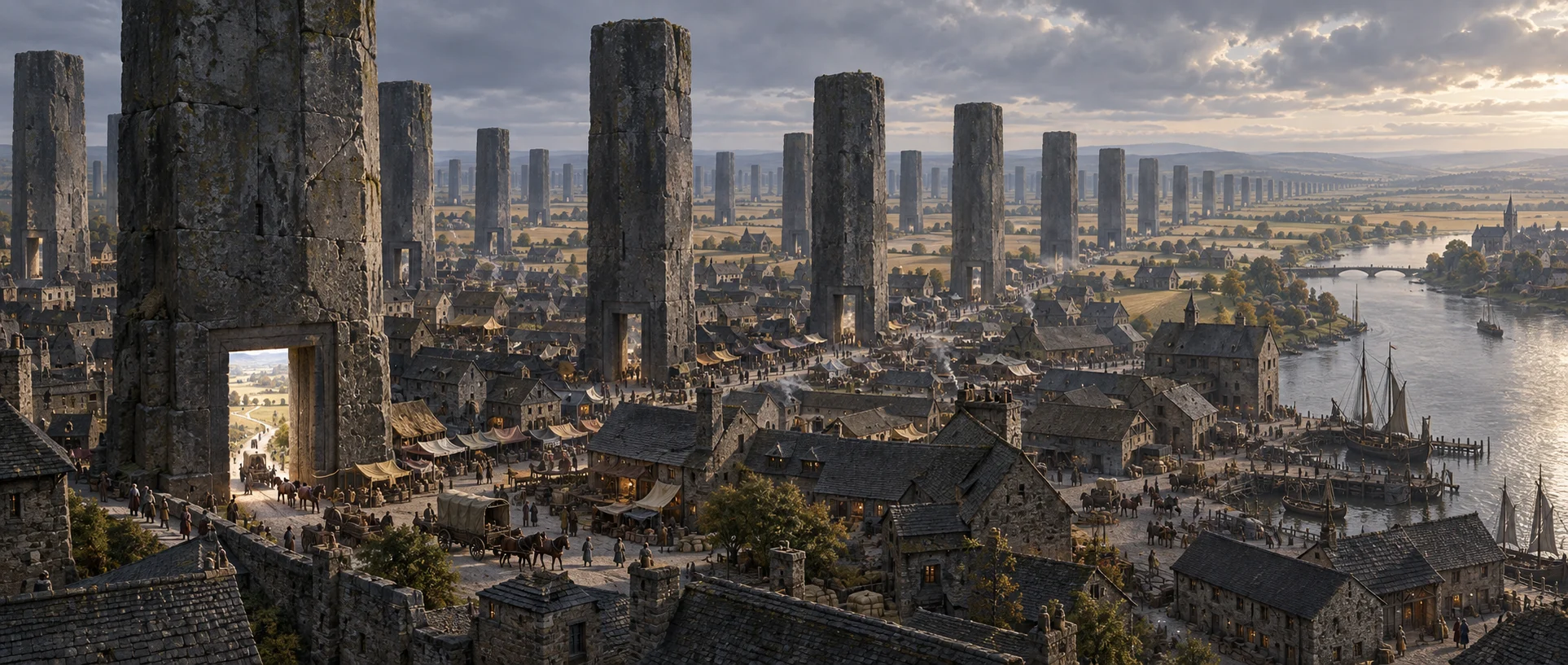
Fetchfield stands among ninety-one stone pillars arranged in long rows across the plain. The smallest is forty metres high. Streets and houses occupy the spaces between them, and their tops are visible from the surrounding farmland. These are waystones, the remains of an ancient magical transport network.
An opening large enough for a loaded wagon passes through the base of each pillar. Most lead to the street on the other side. On an active day, a working stone opens onto a road elsewhere, allowing people and goods to pass through. Four stones have transported anything within living memory; two still work. Market stalls occupy some of the inactive passages. The approaches to the two working stones are kept clear, with warehouses and yards for waiting carts alongside them.
House Sorrenmark rules Fetchfield and sells places in the queue, which can be traded years in advance. Forged priority documents are the city’s most common crime. Four centuries of study have produced no reliable way to predict when the stones will work. Recently, a scholar at Sorrenmark’s school has been predicting active days more accurately than chance would explain. She keeps her method in a private book and has twice refused the school’s offer to buy it.
VII.6 · Beamfall
The Solmarch ridge About 44,000 residents
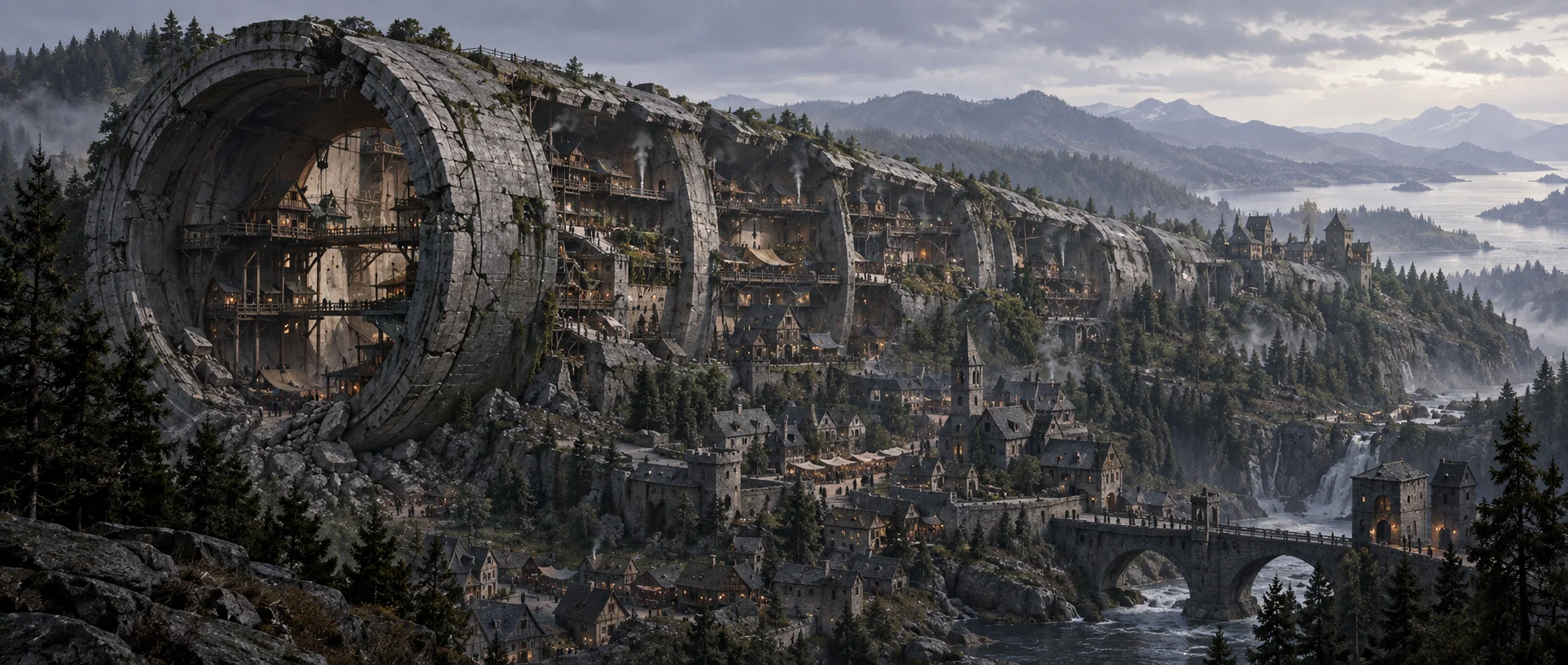
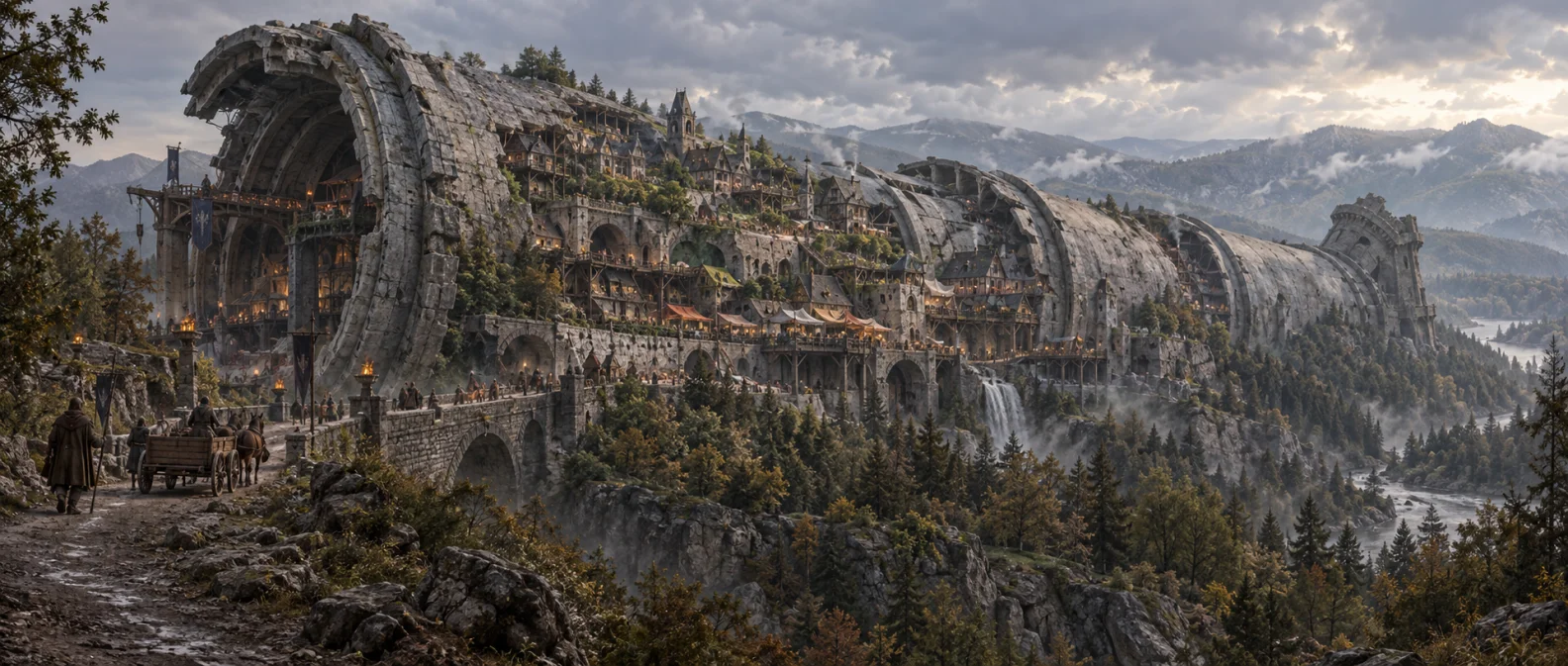
Beamfall occupies a fallen tower eight hundred metres long and nearly two hundred metres across. One side has broken open above the slope, exposing rows of chambers. Houses, markets and gardens fill these openings, connected by wooden balconies and stairs. Farther inside, the tower’s curved outer wall forms a roof over entire districts.
The original floors stand at steep angles or divide neighbouring streets. Residents have fitted level wooden floors across the rooms, while former doorways open above streets or beneath walkways. Large shafts running along the tower serve as covered routes between districts. Its fall predates the city’s surviving records. The tower and adjoining ancient halls could accommodate four or five times the current population, although Beamfall is already the world’s largest city.
House Aldemarch governs Beamfall, but an older elven charter gives House Maeryvane the right to overturn appointments to city offices. It has exercised that right nine times in the past hundred and twenty years. The city trades in timber and oak for shipbuilding. One district belonged to House Solmiryn, whose magical treaty plate cracked after a breach of the Accords. Ownership of that district remains unsettled.
Who keeps the cities running
Five cities belong to ruling houses: dragon-led families and the institutions they control. The Forge is held jointly. A city’s ruler commands its soldiers and courts, collects taxes and controls the gates. Banks, religious orders and trading organisations also hold written exemptions from that authority, accumulated over centuries.
Many of these organisations serve rulers elsewhere. Seizing a local bank could seize another house’s deposits; taking Natronhalt would place other rulers’ family graves under the occupier’s control. These shared interests limit what a city’s ruler can impose. Expensive repairs lead to repeated negotiations over who pays and what rights they receive in return.