
The Wrights
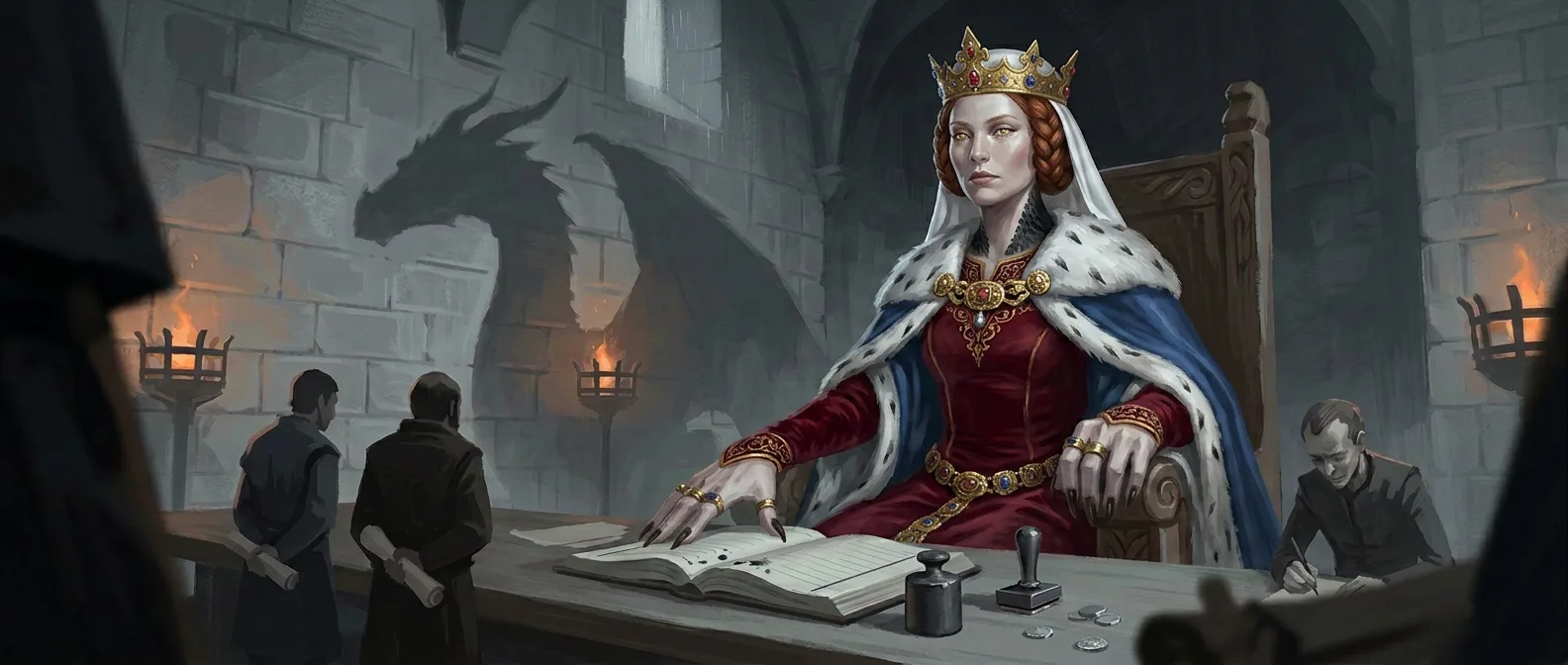
Two centuries of enforced restraint have produced an aristocracy that almost never gets to behave like a predator. Ruling Wrights stay in humanoid form nearly all the time, out of habit rather than concealment, because the second shape is where the work happens: audiences, ledgers, marriages and succession disputes.
Their instruments are patronage, debt, grain and information. The true form is seldom shown outside a Duel of Restraint, and a whole generation of ambassadors has never seen one.
IV.1 · Where does the line run
A Wright can wear any humanoid shape it likes. In practice it has exactly one, worn for centuries, struck on the coinage and known on sight by every subject it has. So the shape is a declaration, and what it declares is one of the two positions below.
- The Undivided
- The line runs between dragon and mortal. The shape is an instrument, no more binding than the chain of office that comes with it, and an Undivided Wright reckons its peers to be the other wyrms. To them Clause I is close to fraternity. The name was chosen as a reply to the halved, and the reply is that a second shape divides the body and not the loyalty.
- The Kinsworn
- The line runs between peoples, and they stand on their own people’s side of it. A dwarven Wright is a dwarf who is also the oldest and largest member of the clan, enrolled in its genealogies and bound by its law. Ask it to choose between the hold and the draconic order and it chooses the hold, and does not experience the question as difficult.
The Undivided call them worn-through; the Kinsworn call the Undivided tenants, quartered on a people and drawing rent. Neither term is used to a dragon’s face at the Forge, and both are used constantly one room over.
IV.2 · The ancestral map
| Ancestry | Position | Why it settled that way |
|---|---|---|
| Dwarves | Kinsworn | A dwarven realm is a clan before it is a state, and clan law has no vocabulary for an owner, only for an elder, so a Wright seated in a hold is enrolled as its eldest member and inherits the obligations that go with the title. |
| Humans | Undivided | Forty generations turn over inside a single reign, which leaves no continuous body of kin for a Wright to be enrolled into, and the human courts are the richest tax base on the continent. Human shape is the working default at the Forge for the same reason. |
| Elves | Neither | Because they remember the same centuries their Wright does, neither kinship nor subjection describes the arrangement, and elven realms have refused both positions in writing at four successive congresses. The elven lines are old and plated all the same, seated in the ring since the signing. |
| Kobolds | Undivided, from below | The one place the hierarchy is insisted on by the ruled rather than the ruler: a kobold Wright that claimed kinship would be understood by its own subjects to be committing blasphemy. |
| Smaller peoples | Kinsworn, mostly | Tengu roost-cities, kitsune courts, catfolk clans and the azarketi river mouths hold a handful of plates between them, and a realm small enough for a wyrm to know by name tends to make a native of it. |
| Goblins, orcs | Contested | Small holdings and thin borders, mostly under primal wyrms, and no settled answer: the question has been reopened by force nine times in two centuries. |
| Gnomes, halflings | No Wright at all | The two peoples with no dragon of their own. Halflings live inside realms held by other people and have held no border a wyrm could be seated behind; gnome shape is First World work and will not sit still, and of the three wyrms recorded as having tried it, none wore one past a century. Neither holds a plate, and both are represented at the Forge only by whoever currently employs them. |
IV.3 · What it does to the Accords
Clause I only works if dragons will side with dragons. That is what the punishment rests on: a house that breaks terms and does not correct itself is attacked by every other dragon at once. The Kinsworn are a hole straight through that assumption. A Kinsworn Wright will not join an attack on a dragon that has done its people no harm, and will join one against a dragon that has, treaty or no treaty. They have kept to the Accords for two hundred years, but by coincidence rather than principle, because their people’s interests happened to point the same way. No one has had to find out how many of them would answer a summons.
The ring is cruellest to the Kinsworn. Keeping a plate warm means producing heirs, and heirs mean marrying another plated house. There are not many of those, and almost none are dwarven — so a Kinsworn hold has to keep marrying in dragons raised Undivided, who then sit at the clan table with a real claim under clan law. Every match brings in a member who does not believe what the house believes about itself. They make the match anyway, because the alternative is a cold plate.
Clause II was written for realms on the surface. It caps a Wright at the land it can fly over in a day — and a dwarven hold does not go outward, it goes down. From the air it is a single gate in a mountainside, so it measures as almost nothing, while inside it holds more people and more wealth than the clause was ever meant to allow. The case law is voluminous and contradictory, and pressing the point gets you a dwarven ambassador politely asking you to define land.
The split is also what predicts how a house votes. An Undivided house pools mortal armies without feeling the cost, and carries most of the weight behind the union faction at the Table. A Kinsworn house will not send its own people to fight over another people's river valley, and is decisive in the ring rather than on the floor.
IV.4 · The True dragons
The few wyrms that never took a second shape, and so are not signatories. They hold no land, sit in no congress and answer no letters, and a Wright can rule out a whole reign without one coming down — when one does, no Wright will fly up to meet it, because the moment they do their neighbours are free to act, so mortals answer it. What circulates instead of the dragons is their verdict on the Wrights: , Change Shape as a wound rather than a maturation, and the Kinsworn raised as the exhibit. The Wrights call them unfinished, and answer a little too quickly.