
The World
The world is one continent with a great deal of water south of it. The north is tundra behind a shingle coast, cut at one point by a gulf deep enough to carry shipping. Two mountain systems cross the middle, a western arc and a longer central spine, with volcanic ground threaded along the spine and cave systems opening underneath it. South of the mountains the land opens into grassland and forest. Clause II caps a realm at what a Wright can personally overfly in a day. Around a hundred powers hold ground on that scale — the eighty-one plates and a few dragons outside the treaty — and each of them is divided again into vassals, client kingdoms, free cities and clan holds, so most borders on the map have more than two parties with an interest in them.
VI.1 · The map
The map is twenty-four hexes across and twenty-four down, under a six-by-six grid of larger cells, each four hexes square. Positions are a hex column and row, the pair every house page prints. One hex is a day's carting on a made road over open ground, which is the unit every distance on the site is quoted in. Off the road it is nearer three days, and a hex of mountain costs three days by road and six without one, which is why the spine is crossed at the passes or not at all.
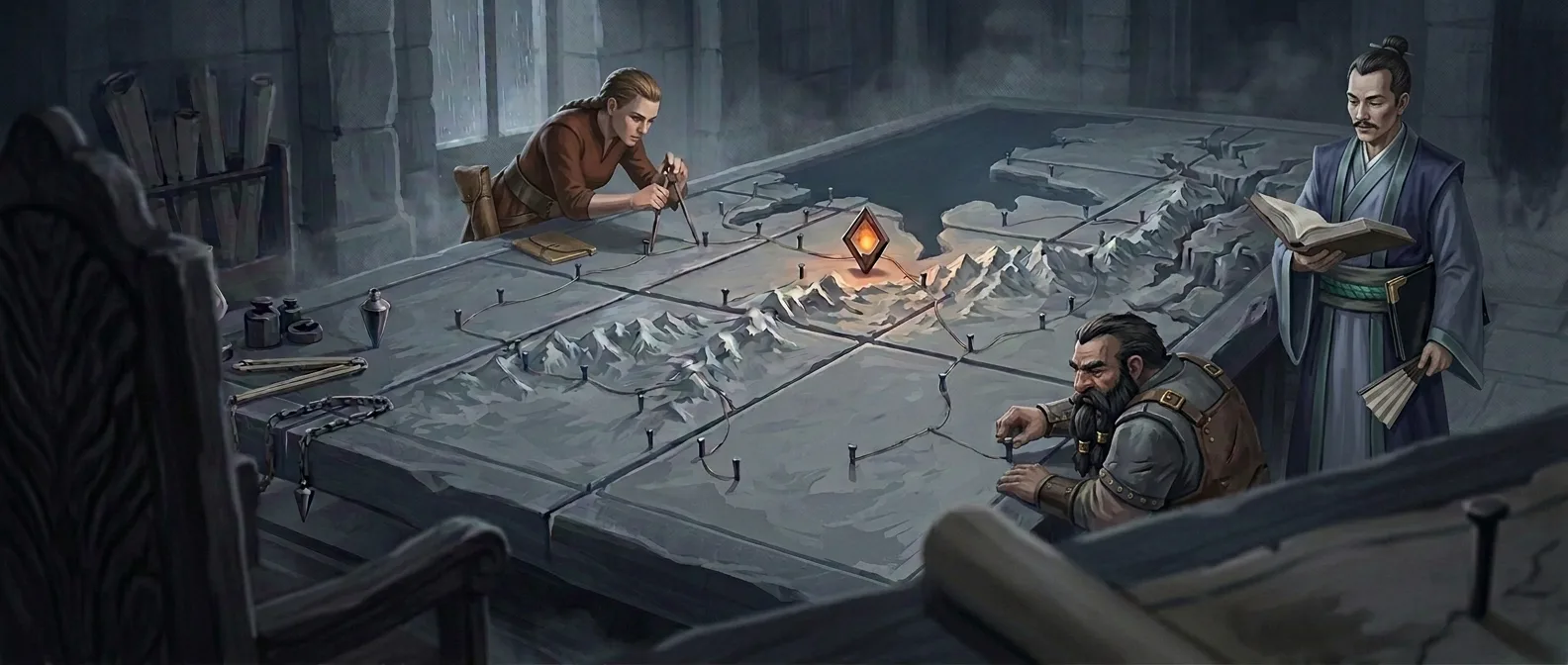
The pale dots are the eighty-one seats, one to a plate, and the ember diamonds mark the six found cities. Select a city to read about its ancient landmark. The warm lines are the seventeen routes that have a name of their own; the grey lines are trade, where the goods actually move as against where somebody built a road, thicker for heavier traffic. On Realms the coloured patches are what each house holds, sized by band. Point at any hex to read what is on it and who holds it, or click the map and walk it with the arrow keys.
Rivers and roads come down to us as a course described in words, never as a line on a map, so both are drawn approximately here and nothing should be measured off them. A realm is the band drawn onto hexes, and the vassals and tribute a large house really runs are not on it at all.
VI.2 · Climate and ground
The north is tundra — frozen peat behind a pebble coast, with the western mountains rising behind it. Barley grows in four places, along the Hrimgard and Storvald shores and rather more of it on the Sunjara Upland, and little else grows at all, so the living comes off the sea. The whaling stations work eight months of the year and stand empty for the other four. Salt, oil, baleen and cut timber go south, and barley comes back north.
The middle of the map is rock, more mountain than anything else on land, with volcanic waste along the spine where the ground is still active and nothing will grow. What soil there is lies on the flanks. Three galleries — passages cut clean through the rock — are the quickest way east that anyone has, and the houses holding their entrances charge what they like for passage.
South of the mountains the ground opens and warms, into the grassland of the Aurelmarch and then forest, until the land runs out into open sea with a little jungle along the last of the coast. Dry badlands and canyon take the whole eastern edge and come back west along the southern foot of the spine, which is where the caravan roads run.
A third of the map grows food, and half the houses sit on it. A house seated on the spine has iron, coal and a road it can charge for, and buys its grain from somebody else.
VI.3 · The six cultures
Regional worship and the faiths of the empire →
Six cultures share the continent: the Corvantine, the Vaskarne, the Amaseki, the Sekhemri, the Falkvald and the Kazdrunn. Each includes independent realms, holds, free cities and client kingdoms whose people share a language and customs for agreements and burial. Clause II limits the territory of each house. Houses within a culture can trade, form alliances or go to war with one another.
The Cultures map layer shades each cell for the culture most numerous there. Each house also has its own cultural affiliation. Roughly a quarter of the eighty-one houses have their seats in places where another culture forms the majority.
The elven lines predate the six cultures and retain their own traditions. Their realms overlap the areas where the six developed, with substantial minority communities in two cells. Catfolk clans govern their own holdings on the open grass within the Corvantine region. The azarketi hold the river mouths and the southern sea. Gnomes and halflings live throughout the mapped cells, and their communities have no seats among the treaty’s eighty-one plates.
the Corvantine
The Corvantine take pride in organisation and reliability, maintaining a common survey of the Aurelmarch, the largest stretch of good farmland on the map. Milestones mark its paved roads, and standard weights give merchants a consistent measure of grain across the markets. Their bridges remain in service for eighty years; their legions have a reputation for arriving on schedule. Courts decide disputes from documents lodged in records offices, so a tenant can use a registered lease to establish a claim against a landlord. The clerks responsible for these records apply the filing rules closely and insist on the required fees, with little allowance for personal charm or flattery. Foreign employers value Corvantine administrative skills and often find the work slow, particularly when instructions receive a literal reading. Factors carry certified copies abroad and establish records offices in the ports where they trade. After a funeral, the name of the person cremated remains on the census roll until the annual audit, when the family pays to have it removed. Poorer households often leave the name on the roll for another year.
the Vaskarne
The Vaskarne guard the independence of their district assemblies and resist commands from outside them. Around Rookenmarsh, wet forest and marsh unsuitable for ploughing support fishing and a trade in timber and pitch, with tolls collected on the raised roads providing further income. Assemblies meet outdoors, where anyone may speak and agreements take effect when witnesses hear and acknowledge them. Each village appoints rememberers who learn judgements by heart for later recitation; written copies acquire standing once they have been read aloud and answered. Debts are recited in order of age at the summer assembly, with debtors required to feed those attending. The prospect of being named in public leads some households to strain their finances to settle beforehand. Vaskarne hospitality includes generous food and drink, and disputes are usually discussed in measured voices. Families are slow to forgive and may preserve a grievance for three generations. Their dead are sunk in the marsh under a stone, and their names enter the recital alongside the debts. Most Vaskarni houses support the treaty’s limit on territory because it keeps neighbouring holdings small enough for their villages to withstand prolonged disputes.
the Amaseki
The Amaseki cultivate formal manners that visitors often find difficult to interpret, particularly when negotiating in the harbour towns of the southern coast. Harbour trade and silver support these communities, whose shipyards are renowned for the quality of their hulls. Access to the channels is controlled by the pilots’ guild, which can exclude a commercial rival through its pilotage decisions. At a gathering, formal rank determines introductions and seating, and a host can convey refusal by assigning a petitioner a lower seat than expected. Visitors unfamiliar with the practice may take a courteous reception as agreement. Rank also governs the sequence in which parties seal a contract: a junior sealing ahead of a senior can invalidate a document already accepted that morning. About half the lawsuits on the coast concern the proper sequence. The dead are burned and their remains shelved at the house, while their names retain their rank on the family roll. Those inherited positions influence claims to property and frequently determine the outcome of inheritance disputes.
the Sekhemri
The Sekhemri plan over generations and conduct much of their business at an unhurried pace. In the dry canyons of the eastern edge, a share in stored water can be worth more than the ground above it, giving the offices that register those shares much of the local authority. Their engineers find water and build the channels and storage that sustain settlements in this country. Families dry and wrap their dead for placement on shelves in burial caves, then maintain a perpetual water share for the washing rites. This continued care is usually the household’s largest standing charge. Children also inherit their parents’ debts, with default bringing disgrace on the living family and its ancestors. Agreements are carved into the tomb wall of one of the witnesses, so settling a dispute can require the family to open the grave and read the inscription. Sekhemri travellers wear salt-stained linen at the wrist and wait for others to drink first from a shared cup. They often ask new acquaintances about burial plans before occupation, a conversational habit that foreigners frequently find morbid. Their own judgements of foreign burial customs reflect the importance they place on continued care for the dead, and they often regard those customs as neglectful.
the Falkvald
The Falkvald speak loudly in public debate and resist attempts to command their assemblies, where persuasive argument carries considerable weight and offers of payment rarely secure support. They live along the northern coast, working the whaling stations for eight months before the ice closes the season. Skilled seamanship supports their trade in salt and whale oil for barley and cut timber. Local assemblies conduct government and hear disputes outdoors, with attendance open to anyone. Personal standing and the support a ruling receives influence both participation and compliance. Oaths are sworn while a witness holds the speaker’s knife, then recited at each assembly until fulfilled, with outstanding promises recorded as notches in the grip. That public record affects others’ willingness to deal with the swearer, and missed recitations can damage a reputation for keeping promises. Heirs take on the obligations attached to inherited goods. Falkvald hosts are generous with their guests. They take offence readily and usually seek a prompt settlement through discussions that can occupy more time at an assembly than the value of the claim warrants. The dead are weighted and lowered into the sea or buried under an inland cairn, with their names called at three assemblies. Falkvald speakers also ask for an annual public reading of the treaty plates at the Forge, since they regard continued recitation as necessary to keep an oath binding.
the Kazdrunn
The Kazdrunn build for use across generations, with a standard of precision that brings their engineers contracts throughout the continent. An engineering commission can continue while the parties pursue a lawsuit against each other. In their mountain holds and the workings beneath them, mushroom cellars, deep cisterns and underground grain crops supply the inhabitants, while mines and furnaces produce iron, coal and firebrick for export. Silver and lead are also traded. Kazdrunn contract dealings are marked by a literal reading of terms and a detailed memory of grievances, and praise for another’s work is given sparingly. Clan law measures a hold by its gates, a measure their representatives defend when applying the treaty’s limit on territory to underground holdings. The dead are laid in rock behind the active workings, and another course of stone is added to the gate. Because the courses record the hold’s age and burials, strangers are kept from inspecting them closely. Contracts are struck into metal strips and cut in two, one half for each party. The matching edges establish the agreement, making the loss of a half a loss of evidence in any subsequent dispute. Their holds also collect tolls on every road through their ground to the Forge.
VI.4 · The Forge
The Forge is one of six found cities, settlements built around ancient structures their inhabitants cannot reproduce. Read about its circular forge hall and cliffside districts, along with the underground city of Onegate and the fallen tower of Beamfall.
Volcanic rock at the head of the central spine, badlands to the south, mountains closing in on the other three sides, and the Forge in the middle of it belonging to nobody. Three ways reach the walls: the cut stair down from Anvil Stair in the north, the Emberrun barge road up from the Corvantine plain, and the Emberdeep road in from the eastern holds, and all three cross Kazdrunn ground and pay Kazdrunn tolls. The Kazdrunn hold every approach and hold no writ whatever inside the walls, which is the arrangement they were paid for; embassy rent along the stair for one season exceeds what the ore traffic clears in a year.
Every realm keeps an embassy inside the walls, and no signatory may take true form there.